Before the Rain
Leonard pulled the nozzle from the gas tank, gave it a little shake, and placed the nozzle back on the pump. He looked through the station wagon’s rear window. He couldn’t believe all the bags Claire had packed. How long did she think they were going for?
He went inside the brick building and handed cash to the man behind the counter, then left and walked across the lot back to the car. He smelled gas, along with exhaust from a pickup truck left running by the payphone.
Leonard slid onto the driver’s seat and wanted to say something to Claire about why she didn’t need to bring so much stuff for a weekend trip. But he bit his tongue, as he often did. She’d get defensive if he said anything. And it wasn’t like it would’ve made a difference. He was the one who put them back there.
He turned the key in the ignition and felt the pain from his stomach. It was stuffy inside the car, and he lowered his window to let some of the cool September air in from outside. “I’m hungry.”
Claire looked up from the novel open on her lap. “I thought you said you ate when you got up?”
Glancing at the book she was reading, Leonard almost asked what it was about. But he didn’t bother. “I had a bowl of oatmeal.” He fastened his seatbelt. “But that was three hours ago.”
It was a cool September morning, but when he rested his arm on the open window he felt the warmth of the sun. He looked up through the windshield and saw the clouds rolling in.
He’d eaten oatmeal nearly every single day for as long as he could remember. But some days it made him feel tired, and he wondered if Claire had it right about how healthy she claimed it was supposed to be for him. Sometimes he felt weak after eating oatmeal, like he needed a nap. He meant to mention that to his doctor, but never did.
Claire gazed at him, with those glowing brown eyes. “Is that all you ate? Oatmeal?”
“There wasn’t anything else.”
“I told you I bought peanut butter. The kind you like.”
Leonard gave her a quick look, but said nothing.
Claire’s eyes went back to the pages of her book. “We should stop soon. You can’t drive all that way without having food in your stomach.”
Leonard shifted the car into drive and took off across the parking lot. “I’d like to get up there before it rains.”
Claire gave him a quick glance with a small smile on her face—her tiny, crooked grin—but went right back to reading her book. “You know how you get when you’re hungry.”
Leonard once again didn’t respond. He turned onto Route 6 heading for 95, going north. The ride to Kennebunkport was a little over two-and-a-half hours, and it was early enough—ten past seven—they’d beat the morning rush hour in Providence and maybe Boston too. As long as they didn’t stop or get hung up along the way.
Claire had her eyes on her novel, but slowly shifted her gaze to her husband once again. “Who said it was supposed to rain?”
“Who said it? Who do you think? The weatherman.”
“I mean, is it going to rain in Maine?” she said. “Or was this the local weather, at the house?”
Leonard rolled his eyes, shaking his head. He didn’t understand why she had to question everything he said, as if he never knew what he was talking about. “Why else would I say I want to beat the rain if it wasn’t going to rain in Maine?” He almost smiled at the way all the words had rhymed.
Claire’s eyes were back on her book. “You really need to get some food. Is it really going to make a difference if it’s—”
“We’ll eat when we get up closer,” he said, reaching for the radio dial. He switched on talk radio, but after a few minutes didn’t want to hear any of it and turned it off.
They drove in silence for a while, Claire reading her book and Leonard thinking about all the drives they’d made to Maine over the years. There was a time they’d stopped going, when the kids were still around but getting older, when money was as tight as it had ever been.
But now it was just him and Claire, making a trip at least once or twice a year to Kennebunkport, where they rented the same cottage from the same family, going back at least twenty years.
Once they made it through Boston, without hitting much traffic at all, Leonard turned the radio on again. The discussion was about some millionaire—a seventy-two year old man—dating a woman more than half his age.
Leonard’s own daughter was in her thirties. To him, she was still a kid.
What would an old guy like that even talk about with a woman that young? Leonard couldn’t imagine showing his own body to a younger woman, the way his dried skin hung off his bones, his breasts poking out like a woman’s. He glanced down at his stomach hanging over his belt and tried to suck it in.
“Lucky guy,” he said to Claire, referring to the old man, only to see if he could get a rise out of her.
But she looked up from her book and turned to him, eyebrows raised, looking like she’d been somewhere else. “Who’s lucky?”
“Nothing,” he said, shifting his eyes back to the road. He was glad she hadn’t heard what he’d said. She wouldn’t have found it funny.
The truth was, it never crossed his mind to be with anyone else but Claire. They’d known each other fifty-four years, since he was nineteen. Married for fifty-two.
It wasn’t that he didn’t look at other women. Of course he did. But he wouldn’t even think about crossing the line, even if he had the chance.
When he was younger and still employed by the Providence Journal, a female friend he worked with, Peg, used to joke around that Leonard was her work husband. He didn’t even know what that meant, but they’d gotten close in all the years they’d worked together. Close enough, he considered her a friend. He never mentioned her to Claire. Maybe he was afraid he’d talk about her in a way Claire would think there was more to this alleged friendship.
There was a point where Peg seemed to go out of her way to say nice things to him. Or she’d tell him he looked nice, no matter what he wore—usually a tie and a shirt like everyone else—or that he smelled nice whenever he used aftershave.
He remembered the last time he saw her, when he walked her to her car in the garage on Fountain Street. She thanked Leonard, leaned over, and kissed him on the cheek. Once in a while he’d think back to what might’ve happened if he hadn’t backed away from her and headed for his own car.
But Peg was gone two weeks later, moving to Atlanta for her husband’s new job. He never spoke to her again.
He didn’t know if Claire had ever thought about another man at some point in her life. But if maybe once Leonard was gone—assuming he’d go first—she’d end up with one of the old men around town who’d lost a spouse.
Leonard was well aware Claire could’ve done much better than marry someone like him. Better looking, at least. Certainly, someone with more money. It would’ve been smart of her.
But for some reason, she chose Leonard.
Claire had fallen asleep somewhere after Boston, and didn’t open her eyes until they were halfway across the Piscataqua River Bridge. She glanced around for a moment, as if she weren’t sure where they were.
Leonard saw her book on the floor and held the wheel steady with one hand, watching the road as he leaned across to pick it up for her. Handing it to her, he said, “Must be a good book, puts you to sleep in the middle of the day.” He gave her a look, side-eyed, to let her know he was teasing.
Claire checked her watch as she yawned. “It’s not even ten.” She still hadn’t completely woken up, flipping through her book as if she may have lost her place, until she leaned over and picked a photo up off the floor.
Leonard saw it was a picture of their three grandkids when they were little, and watched her stick it in her book, using it as a bookmark.
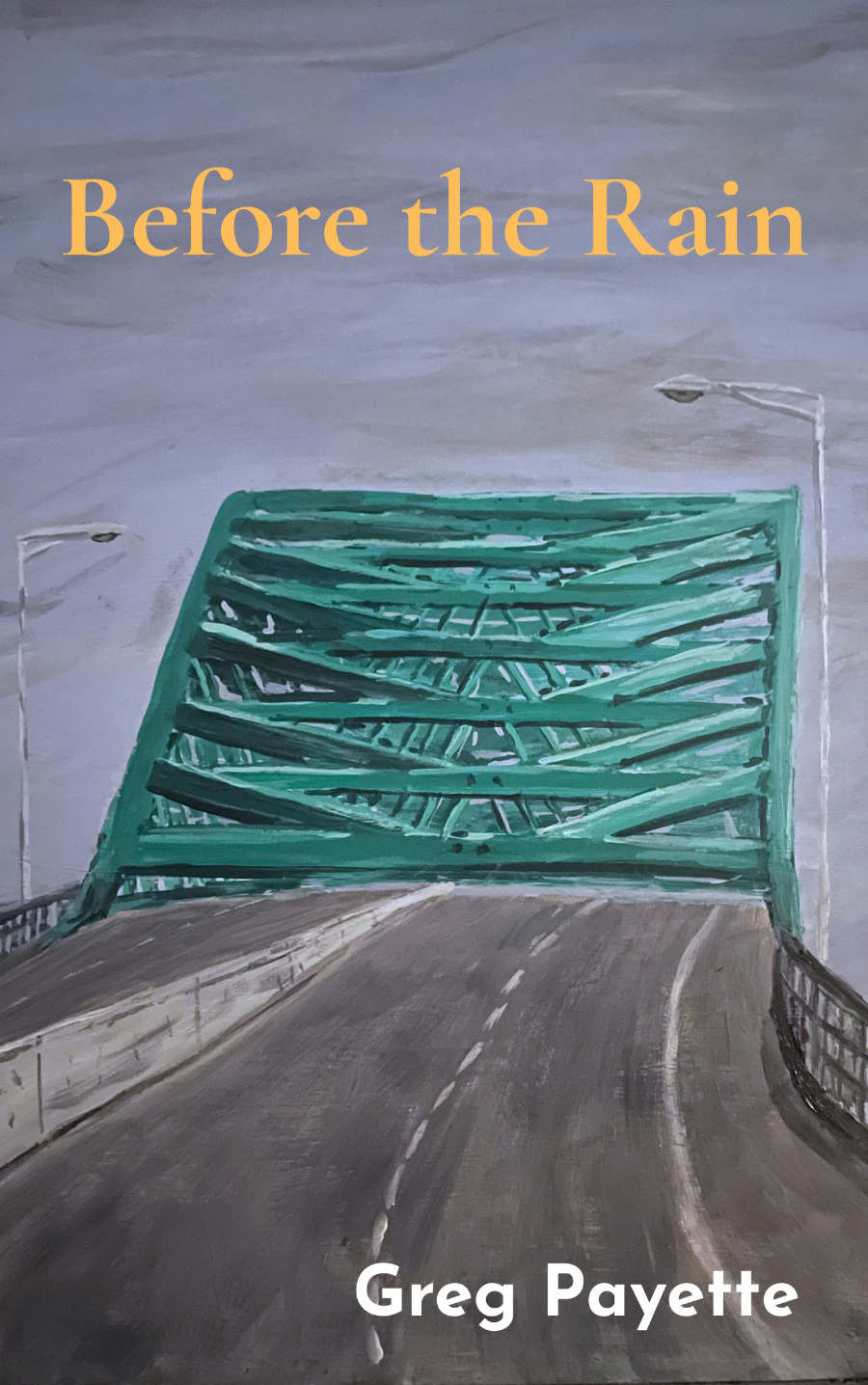
He thought back to all the times they crossed the big green bridge, and how excited the kids would be, jumping up and down in back, practically hanging out the windows looking down at the river.
Whenever they crossed that bridge, it was like a calm coming over Leonard. They’d never lived in Maine, but sometimes it was like home, in a way he could never explain to himself. He missed it when they weren’t there.
“It’s cold,” Clair said, glancing over her shoulder into the back seat. “Where’s my jacket?”
Leonard put up his window, even though he was warm. The sun had been out for most of the drive through Boston and into New Hampshire, but he could see the gray clouds forming ahead. “You sure you brought it?”
“Why wouldn’t I bring my jacket?”
And here Leonard was, thinking he’s the one who got snippy when he was hungry. “I don’t know. I’m just saying. Maybe you left it at the house.”
“Why would I leave it at the house?” Claire rubbed her arms up and down. “Can’t we turn the heat on?”
“It’s sixty-four degrees out.” He grabbed the window crank and made sure the driver-side window was all the way up.
Claire reached for the dashboard and turned on the heat herself.
After a couple of moments, Leonard was sweating. He cracked his window. “Maybe we should pull over, find your jacket. You must have something else in back you can wear, all those bags you brought.”
Turning around in her seat, kneeling now, Claire faced the rear and hung over the backrest. Her rear-end was up in the air, two inches from Leonard’s face. She had her jacket in her hand when she straightened back her seat. “I told you I didn’t leave it.”
“Can we turn off the heat now?” Leonard lowered his window halfway down, and could already smell the difference in the air outside. It was a little cooler—enough he could finally breathe. He was glad summer was over.
The summer traffic to Maine had only gotten worse over the years. And that traffic was another reason they’d stopped going to Kennebunkport. It hadn’t always been that way. Not until the Vice President bought the property at Walker’s Point—three years before he became VP—and changed Kennebunkport into a busy tourist destination.
Leonard didn’t consider himself a tourist, even though that’s essentially what he was whenever they traveled to Maine. Going up once the summer was over made a difference, the way the locals looked at him without the crowds.
He was happy once the humidity that clung to New England each summer disappeared. The older he got, the more he appreciated fall. It was the best of the four seasons. He’d even started looking forward to the winter months, which was uncommon amongst the people he knew in Rhode Island. Leonard’s friends were the ones who hit the road to Florida as soon as the clocks got set back.
He didn’t even mind the darkness so early. He preferred the light in the early mornings to evenings anyhow, when all he did after dinner was look forward to going to sleep so he could get up early and start his day when most people were still in bed.
Claire had slipped on her jacket and finally turned off the heat. “What happened to getting something to eat?” She looked at her watch again. “You said you were hungry almost two hours ago. You must be starving now.”
Leonard peered ahead at signs warning of tolls in Kittery. “Let’s get a little closer. Maybe we can stop at the diner. I wouldn’t mind a lobster roll.”
“For breakfast?” Claire said.
Leonard didn’t respond. He didn’t bother reminding her that he’d already eaten breakfast. It wasn’t out of the ordinary for him to have lunch well before noon, unless Claire was making something special. Then he’d have to wait. Their schedules were off by at least a few hours, and he never understood how she could stay in bed so late some mornings, lying there doing nothing.
His stomach grumbled well before Boston. Now he could taste his hunger in his mouth, like something was rotten. But he wanted to keep driving.
He pushed each button on the radio looking for something to listen to, but only got static. He turned the dial until he finally picked up an AM station. It was talk radio again, and the man mentioned rain on the way. Leonard glanced at Claire to make sure she’d heard it. But she wasn’t paying attention, looking out the passenger window as they drove past the tall evergreens along 95.
He wasn’t always so concerned with driving in the rain. But Kennebunkport consisted mostly of back roads. Especially on the way to the cottage. They were narrow and twisty and went through heavily wooded areas. It was hard enough when the roads were dry.
When he was young, he drove fast everywhere he went, as if he was always in a hurry. It didn’t matter if the roads were narrow. But at some point, he drove much slower. He’d grip a little tighter with both hands on the wheel, the way drivers got taught back in the day. He had a hard time remembering when it all changed, when taking things slow seemed like the right thing to do.
He tried to tell himself to loosen up, and that it made sense to take more risks in old age than in youth. A kid has all those years ahead, so why put such a long life in jeopardy with so much to look forward to? At seventy-two, Leonard believed he had little time left. Why not push himself? What was there to lose? But that wasn’t how the brain worked.
He’d actually had the same conversation with the handful of friends he still had—the ones he met for coffee once or twice a month. Nobody seemed to agree. “We’re wiser now,” one of them said. In the last conversation, Leonard decided he didn’t want to talk about age or ailments anymore.
It seemed that’s all they did.
He’d shift the conversation to something neutral, like one about the Red Sox or Celtics, Patriots or Bruins—depending on the season—but somehow it would always shift back to a topic reminding them all they were old.
He wondered how some people seemed to be happy in old age. How was that possible? Maybe it was the ones who had money, could afford to take trips to tropical islands. He wouldn’t know.
Leonard eased off the gas and drove slowly toward the toll, dropping the quarter in the basket.
Claire pointed to the sign for the next exit. “Aren’t we close enough now? Let’s eat. I’m hungry.”
“Didn’t you eat breakfast?”
Claire shook her head.
“It’s only another twenty minutes to the diner,” Leonard said.
Claire sighed. “What if there’s a line?”
Leonard said, “There won’t be a line. All the tourists are gone.”
A drop of rain hit the windshield. And then another. And another. Leonard turned on the wipers.
Claire let out a sigh, opened her book and removed the photo of their grandkids from between the pages, then reached forward and turned the heat on.
The rain was coming down now. But Leonard didn’t mind it. In fact, he thought about how it would be perfectly fine if it rained all weekend and they never left the house.